On Wealth and Poverty
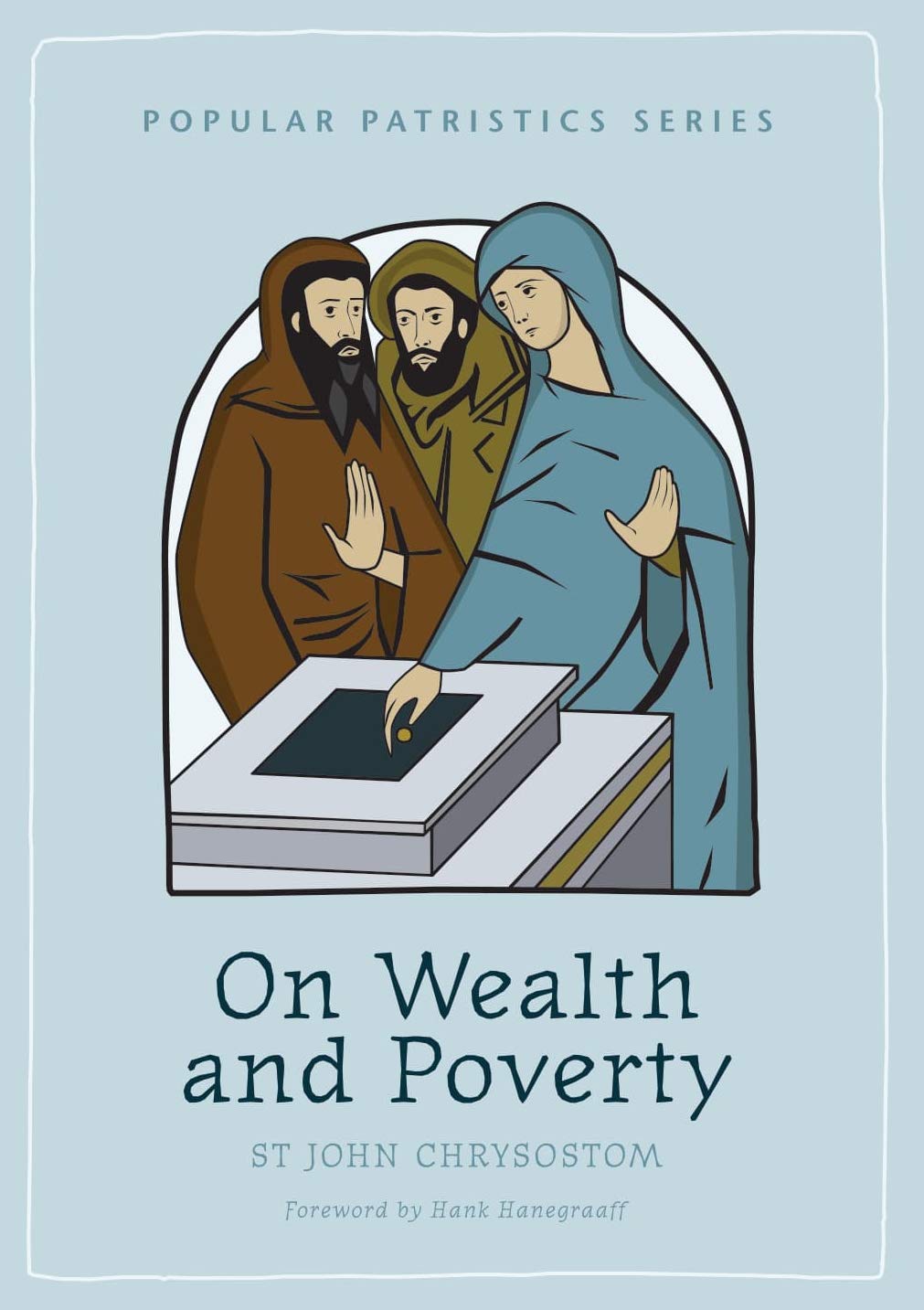
Six sermons on the parable of Lazarus and the rich man, together with Catharine Roth's introduction to the volume. The first was delivered on 2 January, the morning after the Saturnalia, to a congregation still full of the previous night's excess.
What follows are the passages I marked and what I made of them. Page numbers refer to the Popular Patristics edition; quotations from the translator's introduction are marked as such.
Contents
Introduction
John’s mother Anthusa devoted herself to raising her son, providing his basic religious and moral training.
Introduction, p. 9
Under the influence of the beloved archbishop of Antioch, St Meletius, John received baptism when he was about twenty years old.
Introduction, p. 10
The congregation often interrupted his preaching with applause, but did not necessarily put his advice into practice. He rebuked people for coming to church only for the beginning of the Liturgy and departing with the catechumens after the sermon; he did not want the faithful to make listening to his sermons a substitute for participation in the liturgical prayers and the holy Communion.
Introduction, p. 11
The preaching being interrupted by applause is not something to be encouraged, yet there are many examples to the contrary these days.
During his priesthood in Antioch, St John preached his series of sermons on the parable of Lazarus and the rich man, perhaps in 388 or 389. He began on January 2, referring to the riotous celebrations of the Saturnalia on the previous day, which marked the beginning of the civil year. While the parties, carousing, and entertainments went on, faithful members of the church had been listening to John exhort them to do everything for God’s glory. Now they were back for the second day, and he introduced the parable. On the next two occasions, probably the next two Saturdays or Sundays, he continued to preach on the parable. The fourth time, he told his congregation, he would have finished explaining the parable if it had not been necessary to praise the local martyrs St Babylas and Saints Juventinus and Maximinus.6 The feast day of St Babylas is 24 January, about three weeks after the first sermon on Lazarus; Juventinus and Maximinus were honored a few days later. On the next occasion after that, St John concluded with the fourth sermon on the parable. A week later, probably, he began the fifth sermon of the series by saying that he could speak more on the parable, but to keep his hearers from being surfeited he would discuss another text instead.
The sixth and seventh sermons were given later on, but while the parable was still on his mind and his congregation’s—perhaps later the same year. The sixth was preached after an earthquake, when it seemed timely to speak of God’s judgment and the necessity of choosing the right way of life before it was too late. The seventh sermon begins as an admonition to those who frequent the racecourse, with the text, “Enter by the narrow gate”; Lazarus and the rich man came easily to the preacher’s mind as travelers by the narrow way and the easy road respectively.
Introduction, p.12-13
The parable passes over the moral qualities of the two men, so St John must discuss what is wrong with the life of luxury and what is good about the life of poverty. Are all the rich condemned and all the poor saved? No, although the poor have a better chance. The rich man’s chief fault was his failure to give alms; he neglected the duty of helping his neighbor.
Introduction, p. 13
Counterpoint to those who ignorantly say that bible teaches that riches are wrong
Conscience should induce us to admit our sins (apparently St John is thinking of confession made privately to God, sacramental confession before a priest not having yet become a general custom).
Introduction, p. 16
Would be interesting to read about the history of the development of sacramental confession
St John says that Christians who were seen at the races set a bad example for prospective converts. Besides, they were wasting their time, and, above all, nullifying the work of spiritual training that they had undertaken in the church. Perhaps, like some people nowadays, they were making sport a substitute for religion, with their zealous attachment to one charioteer or another. In any case, they were walking on an easy road and would come to a bad end.
Introduction, p. 18
This is quite common, yet, this is something that flies under the radar as an innocent little thing. Many things can become idols, yet the worst are those that seem innocuously but are the most dangerous.
First Sermon
For we are made in such a way that we are not bitten so hard by our misfortunes when no helper is present as when people are present but unwilling to stretch out a hand; and this was his situation at that time. For there was no one to console him with a word or comfort him with a deed, no friend, neighbor, or relative, not even any onlooker, since the rich man’s whole household was corrupt.
p. 30–31
I am ashamed, indeed, and I blush to put these expressions before you, except that it is necessary to say these things, to free you from the disorderly humor, the shame, and the harm that comes from such talk. Many people often say these things with a laugh, but even this belongs to the evil methods of the devil, to introduce corrupt teaching into our life in the guise of humorous expressions. Many people use these phrases continually in workshops, in the marketplace, and in their houses: this is a mark of extreme unbelief, of real mania, and of a childish disposition. To say, “If the wicked are punished when they depart,” and not to be thoroughly convinced that they surely will be punished, is characteristic of unbelievers and skeptics. If this indeed should happen (and it surely will happen), to think that the wicked will have enjoyed an equal reward with the righteous indicates the height of foolishness.
p. 33
Do not tell me that he was afflicted with sores, but consider that he had a soul inside more precious than any gold—or rather not his soul only, but also his body, for the virtue of the body is not plumpness and vigor but the ability to bear so many severe trials. A person is not loathsome if he has this kind of wounds on his body, but if he has a multitude of sores on his soul and takes no care of them. Such was that rich man, full of sores within. Just as the dogs licked the wounds of the poor man, so demons licked the sins of the rich man; and just as the poor man lived in starvation of nourishment, so the rich man lived in starvation of every kind of virtue.
p. 35
But with God we cannot say this; for no one will escape his judgment, but all who live by fraud and theft will certainly draw upon themselves that immortal and endless penalty, just like this rich man. Collecting all these thoughts in your minds, therefore, my beloved, let us call fortunate not the wealthy but the virtuous; let us call miserable not the poor but the wicked. Let us not regard what is present, but consider what is to come. Let us examine not the outer garments but the conscience of each person. Let us pursue the virtue and joy that come from righteous actions; and let us, both rich and poor, emulate Lazarus. For this man did not endure just one or two or three tests of virtue, but very many—I mean that he was poor, he was ill, he had no one to help him. He remained in a house that could have relieved all his troubles but he was granted no word of comfort. He saw the man who neglected him enjoying such luxury, and not only enjoying luxury but living in wickedness without suffering any misfortune. He could not look to any other Lazarus or comfort himself with any philosophy of resurrection. Along with the evils I have mentioned, he obtained a bad reputation among the mass of people because of his misfortunes. Not for two or three days but for his whole life he saw himself in this situation and the rich man in the opposite. What excuse will we have, when this man endured all the misfortunes at once with such courage, if we will not bear even the half of these? You cannot, you cannot possibly show or name any other who has suffered so many and such great misfortunes. For this reason Christ set him before us, so that whatever troubles we encounter, seeing in this man a greater measure of tribulation, we may gain enough comfort and consolation from his wisdom and patience. He stands forth as a single teacher of the whole world, for those who suffer any misfortune whatever, offering himself for all to see, and surpassing all of them in the excess of his own troubles.
p. 36–37
Second Sermon
Let us learn from this man not to call the rich fortunate nor the poor unfortunate. Rather, if we are to tell the truth, the rich man is not the one who has collected many possessions but the one who needs few possessions; and the poor man is not the one who has no possessions but the one who has many desires.
p. 40
For whoever has no need of others’ property but is happy to be self-sufficient is the most affluent of all.
p. 40
Scripture calls a man son and brother of the one whose character he shares.
p. 41
Thus, God is our father when we have character like Him, and the devil is our father when we have a character like the devil.
Are you listening to this in silence? I am much happier at your silence than at applause; for applause and praise make me more famous, but this silence makes you more virtuous.
p. 44
This is what the character of a preacher should be. A reflective audience, not one that makes outward noise.
For just as the poor man’s torment was made harsher by the fact that he lay at the gate of the rich man and saw others’ prosperity, so the rich man’s retribution was made harsher by the fact that he lay in hell and saw Lazarus’ comfort, in order that he might have a more unendurable punishment not only by the nature of his torments but also by the comparison of the other man’s reward.
p. 47
the rich man is a kind of steward of the money that is owed for distribution to the poor. He is directed to distribute it to his fellow servants who are in want. So if he spends more on himself than his need requires, he will pay the harshest penalty hereafter. For his own goods are not his own, but belong to his fellow servants. Therefore let us use our goods sparingly, as belonging to others, so that they may become our own. How shall we use them sparingly, as belonging to others? When we do not spend them beyond our needs, and do not spend for our needs only, but give equal shares into the hands of the poor.
p. 48–49
It is also worth inquiring why the rich man does not see Lazarus with any other righteous man, but in the bosom of Abraham. Abraham was hospitable. The rich man sees Lazarus with Abraham, in order that Lazarus also may convict him of inhospitability.
p. 49
The poor man has one plea, his want and his standing in need: do not require anything else from him; but even if he is the most wicked of all men and is at a loss for his necessary sustenance, let us free him from hunger. Christ also commanded us to do this, when he said, “Be like your Father in heaven, for he makes his sun rise on the evil and on the good, and sends rain on the just and on the unjust.”
p. 50
Charity is so called because we give it even to the unworthy.
p. 51
Thus, if we meet someone on the street who has the appearance of a pauper, we should not think about their unworthiness, but give because God’s grace has given us so much without us being worthy of it.
“Do not add grief to the troubled soul,” it is written. His punishment is sufficient; let us not trample further on his misfortunes. Besides, to keep the rich man from thinking that out of malice he was preventing Lazarus from going, he called him “son,” all but apologizing for himself by this form of address.
p. 52
I beg you, remember this without fail, that not to share our own wealth with the poor is theft from the poor and deprivation of their means of life; we do not possess our own wealth but theirs. If we have this attitude, we will certainly offer our money; and by nourishing Christ in poverty here and laying up great profit hereafter, we will be able to attain the good things that are to come
p. 53
Third Sermon
For this reason also I often tell you many days in advance the subject of what I am going to say, in order that you may take up the book in the intervening days, go over the whole passage, learn both what is said and what is left out, and so make your understanding more ready to learn when you hear what I will say afterwards.
p. 55–56
It seems that the layman could take up the book and go over the whole passage on their own, which is very different from the stereotype one would have in mind when thinking of that time.
when you are at home, to persevere continually in reading the divine Scriptures.
p. 56
They had the divine Scriptures at home to read
The ignorance of Scripture is a great cliff and a deep abyss; to know nothing of the divine laws is a great betrayal of salvation.
p. 57
why did Abraham not say to him, “You have received your good things,” but, “You have received the good things due to you,” as if they were debts owed to him? What do we learn from this? That even if some people are foul and have reached the extremes of evil, often they have done one or two or three good things.
p. 59
God is Just, so he will never shortcharge us. His mercy and grace actually gives us much more than we deserve. (context is about what Abraham says to the rich man)
Therefore when you see anyone living in wickedness but suffering no misfortune in this life, do not call him fortunate, but weep and mourn for him, because he will have to endure all the misfortunes in the next life, just like this rich man. Again, when you see anyone cultivating virtue, but enduring a multitude of trials, call him fortunate, envy him, because all his sins are being dissolved in this life, and a great reward for his endurance is being prepared in the next life; just as it happened for this man Lazarus.
p. 60
Pray for the ones who are wicked, so that God changes their heart and brings them to Himself and grants them salvation.
When we sinners receive honor from God, this very fact will be able to cast us deeper into the fire. If one who enjoys only God’s forbearance does not make good use of it, he will have a more severe retribution
p. 61
Repent while you still have the chance, and do not disregard God’s favour upon you.
Just as among sinners, therefore, those who suffer no misfortune here submit to a greater retribution hereafter, so among the righteous those who suffer any misfortunes here will enjoy great honor hereafter.
p. 63
For the devil brings a multitude of misfortunes for this purpose, to lead you down into that pit. If he sees you blaspheming he will readily increase the suffering and make it greater, so that when you are pricked you may give up once again; but if he sees you enduring bravely, and giving thanks the more to God, the more the suffering grows worse, he raises the siege at once, knowing that it will be useless to besiege you any more.
p. 65–66
Job is an example to the contrary, but he is an outlier and there are few like him. God will never let you be tested more than you can handle, but if you already blaspeheme Him in what you can handle, your salvation will be in peril.
Besides, if the tribulation and trial of poverty were the cause of blasphemies, all those in poverty would have to blaspheme; but in fact many of those who live in extreme poverty give thanks continually, while others who enjoy wealth and luxury do not cease blaspheming. So it is not the nature of our external circumstances but our own choice that causes one and the other.
p. 67
In summary, every punishment, if it happens to sinners, reduces the burden of sin, but if it happens to the righteous, it makes their souls more splendid. A great benefit comes to each of them from tribulation, provided that they bear it with thanksgiving; for this is what is required.
p. 69
Fourth Sermon
Nothing tends so much to disturb and scandalize the majority of people as the fact that rich people living in wickedness enjoy great good fortune while righteous people living with virtue are driven to extreme poverty and endure a multitude of other troubles even worse than poverty. But this parable is sufficient to provide the remedies, self-control for the rich and consolation for the poor.
p. 77
“If they do not hear Moses and the prophets, neither will they listen if someone rises from the dead.” And the Jews proved that this is true, that he who does not hear the Scriptures will not hear even those who rise from the dead; for when they had not heard Moses and the prophets, neither did they believe when they saw some of the dead rising. Instead at one time they tried to kill Lazarus; and at another time they assaulted the apostles, although many of the dead had risen at the hour of the Cross.
p. 79–80
While we are in the act of sinning we do not perceive as keenly because we are made drunk by the pleasure; but when it is done and reaches its end, then especially, after all the pleasure is quenched, the bitter goad of repentance comes upon us, just the opposite of women in labor.
p. 83
The sin does not become more burdensome because of your self-accusation, does it? Rather it becomes easier and lighter. For this reason he wishes you to confess, not in order to punish you, but in order to forgive you: not in order that he may learn your sin (how could that be, since he knows already?), but in order that you may learn how great a debt he forgives you.
p. 84
Ask for forgiveness of your sin with urgency and contrition and God will forgive you and bring you relief.
The jealous person would prefer to suffer innumerable troubles rather than to see his neighbor in good repute, even if the cause of the good repute were to benefit him also.
p. 86
Sixth Sermon
No fifth sermon
Why do we grieve for those who are being punished, but not for those who are sinning? Punishment is not as grievous as sin, for sin is the reason for the punishment.
p. 95
Grieving for our sins and the sins of others is more important than grieving for their pain and punishment, which are there to correct them.
Lazarus, you see, was lying at the gate, wounded, wasting away with hunger. The dogs came and licked his wounds: the dogs showed more love of mankind than the man did, when they licked his wounds and cleaned and removed the infection.
p. 100
The present world is a theater, the conditions of men are roles: wealth and poverty, ruler and ruled, and so forth.
p. 102
People have been saying this much before Shakespeare
Do you have a wicked woman as your mother? It has nothing to do with you. Just as a good mother’s virtue does nothing to help you unless you emulate it, so also a bad mother’s wickedness does not harm you if you adopt a different way of life.
p. 104
This talks against prejudicing ourselves based on the family background of an individual rather than the individual himself.
These stories are mysteries, and the events are a type of what was to come: that is, the ark represents the Church, Noah represents Christ, the dove represents the Holy Spirit, the olive branch represents God’s love for mankind.
p. 105
for often one iota or one dot awakens an idea.
p. 109
E.g. Homoousious vs Homoiousious
Often from a clear conscience a person has come into arrogance; and the harm that sin did not do to him is done by his arrogance.
p. 112
As I said, neither is anyone so good as not to have a small stain, nor is anyone so bad as not to have even a small good quality.
p. 113
So when you see a righteous person punished in this life, consider him fortunate, and say, “This righteous person either has some sin, and is receiving what is due for it and departing clean to the other life; or else he is being punished more than his sins, and a surplus of righteousness is being reckoned to him.”
p. 115
Seventh Sermon
For this reason he says, “The gate is wide and the road is easy that leads to destruction, and those who enter by it are many.” Well did he call it a wide gate and an easy road that leads to destruction. For those who are eager to go to the races and the other satanic spectacles, who have no care for self-control and give no thought for virtue, who wish to behave recklessly, who yield themselves to luxury and gluttony, who spend themselves every day in madness and frenzy for money, who strain after the things of the present life—these people walk by the wide gate and the easy road. But when they go farther along, and gather a great burden of sins for themselves, when they are all spent and come to the end of the road, they are no longer able to go any farther, because they are pressed tightly by the narrowness of the road and burdened by the weight of their sins so that they cannot go through. So they must come at last to the very brink of destruction. What benefit is it, tell me, after walking on the easy road a little while, to come to a permanent destruction; after luxuriating in a dream, so to speak, to be punished in truth?
p. 121
In Switzerland, this might be people going hiking on a sunday (instead of going to church) or something similar and wordly.